Farmer 1: Hello, I haven’t seen you for a while. How are you? Farmer 2: Good morning. I’m fine, thank you, and how are you?
R1: Now everything is fine, but I’ve had some problems with my cows lately.
R2: O, what happened?
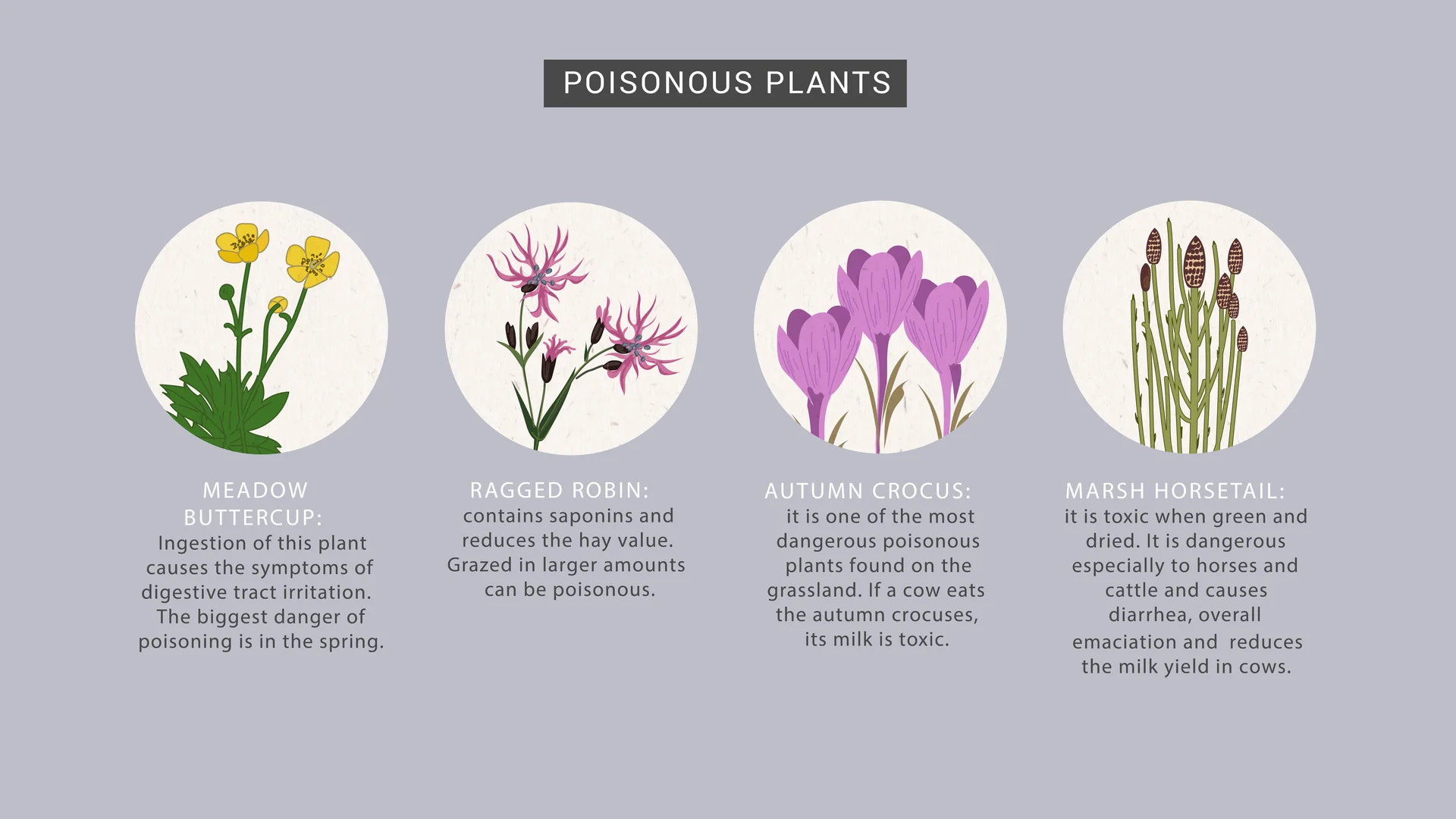
R1: They got poisonedmfd0575a6467c7d65_1510573124781_0poisoned on the pasturemfd0575a6467c7d65_1510574423856_0pasture with the leaves of a plant called Meadow buttercupmfd0575a6467c7d65_1510574438619_0Meadow buttercup?
R2: How did you notice it?
R1: The symptoms were rather worrying: salivationmfd0575a6467c7d65_1510574459768_0salivation, tremormfd0575a6467c7d65_1510575110029_0tremor, polyuriamfd0575a6467c7d65_1510575124316_0polyuria, mooingmfd0575a6467c7d65_1510575441099_0mooing and spinning around, vomitingmfd0575a6467c7d65_1510575453992_0vomiting and bloody diarrheamfd0575a6467c7d65_1510575468007_0bloody diarrhea. I called a vet and he explained me everything.
R2: Tell me about it, because I also let my cows around near your cows.
R1: We can take a walk and look for toxic plants on your pastures and mines as well. I heard that we can encounter here several of the species. R2: Which ones?
R1: For example, cicuta virosamfd0575a6467c7d65_1510575487216_0cicuta virosa which is poisonousmfd0575a6467c7d65_1510575609309_0poisonous in every form: green, dried and ensiledmfd0575a6467c7d65_1510575643915_0dried and ensiled. All its parts are toxicmfd0575a6467c7d65_1510576141880_0toxic: leavesmfd0575a6467c7d65_1510576236795_0leaves, stemsmfd0575a6467c7d65_1510576748858_0stems, rhizomesmfd0575a6467c7d65_1510579906507_0rhizomes and inflorescencemfd0575a6467c7d65_1510579961187_0inflorescence.
R2: And what else?
R1: In our area, there is also Heracleum sosnowskyi Mandenmfd0575a6467c7d65_1510579987373_0Heracleum sosnowskyi Manden and Meadow buttercup which my cows got poisoned with. Meadow buttercup is dangerous only before the blooming. Then, it produces yellow flowers and the animals avoid it themselves. Heracleum sosnowskyi Manden may severely burn the cows.
R2: Do you know how these plants look like?
R1: Yes, I know, I have pictures.
R2: Super. Then let’s go and see if they are somewhere on our pastures.
Farmer: Good morning. Can you tell me how should I feed my pigs? Technician: Of course. I see that you have quite a big herdmfd0575a6467c7d65_1510581732942_0herd. How many pigs are here? F: Around 250 pigs and 15 sowsmfd0575a6467c7d65_1510581833251_0sows which will soon farrow. T: It’s really a lot. The principles of feeding of the pigs depend on the purpose of their breeding and the age of the animals. F: Tell me please, what are the principles of feeding my herd? T: The most important thing is the energy value of the feedmfd0575a6467c7d65_1510582032746_0energy value of the feed. It should be higher in case of very small animals and nursing sows, and in case of older animals it can be slightly lower. To obtain a high energy concentrationmfd0575a6467c7d65_1510582923134_0energy concentration, it is recommended to use large amounts of foddersmfd0575a6467c7d65_1510583112162_0fodders. Good daily weight gainsmfd0575a6467c7d65_1510583136578_0weight gains may be achieved, even 700‑800 g per day during the whole fattening periodmfd0575a6467c7d65_1510583322649_0fattening period. F: And do the pigs digestmfd0575a6467c7d65_1510583392636_0digest everything they eat? T: Unfortunately not, that’s why the digestibility of the nutrients should be above 80%. The content of fibremfd0575a6467c7d65_1510583407251_0fibre is decisive in whether the nutrients are digestible or not, so the ration cannot have too large amount of fibre – it should be 5‑6% in dry mass of a portion for fattening pigsmfd0575a6467c7d65_1510583469826_0fattening pigs and 10% for the sows. F: And what about proteinsmfd0575a6467c7d65_1510583768173_0proteins? I know from my friend that it is a very important nutrient. T: Yes, certainly. The content of proteins in a ration depends on the needs of a pig and this element should be balancedmfd0575a6467c7d65_1510584228629_0balanced very carefully. But in the feeding of pigs the quality is especially important. High biological value of protein in the ration may be obtained for example by adding fish feedmfd0575a6467c7d65_1510584248614_0fish feed, skimmed‑milk powdermfd0575a6467c7d65_1510584267239_0skimmed‑milk powder or soybean mealmfd0575a6467c7d65_1510584327386_0soybean meal. Additionally, synthetic aminoacidsmfd0575a6467c7d65_1510584367270_0synthetic aminoacids may be added in premixesmfd0575a6467c7d65_1510584349909_0premixes.
Farmer: Good morning. I want to set up a cattle farm but I don’t know which breedmfd0575a6467c7d65_1510586311768_0breed should I choose. Can you give me some advice? Technician: Of course. Generally, there are 2 types of cows – dairy cowsmfd0575a6467c7d65_1510586610383_0dairy cows and meat cowsmfd0575a6467c7d65_1510586627702_0meat cows. Do you know which type would you like to rear?
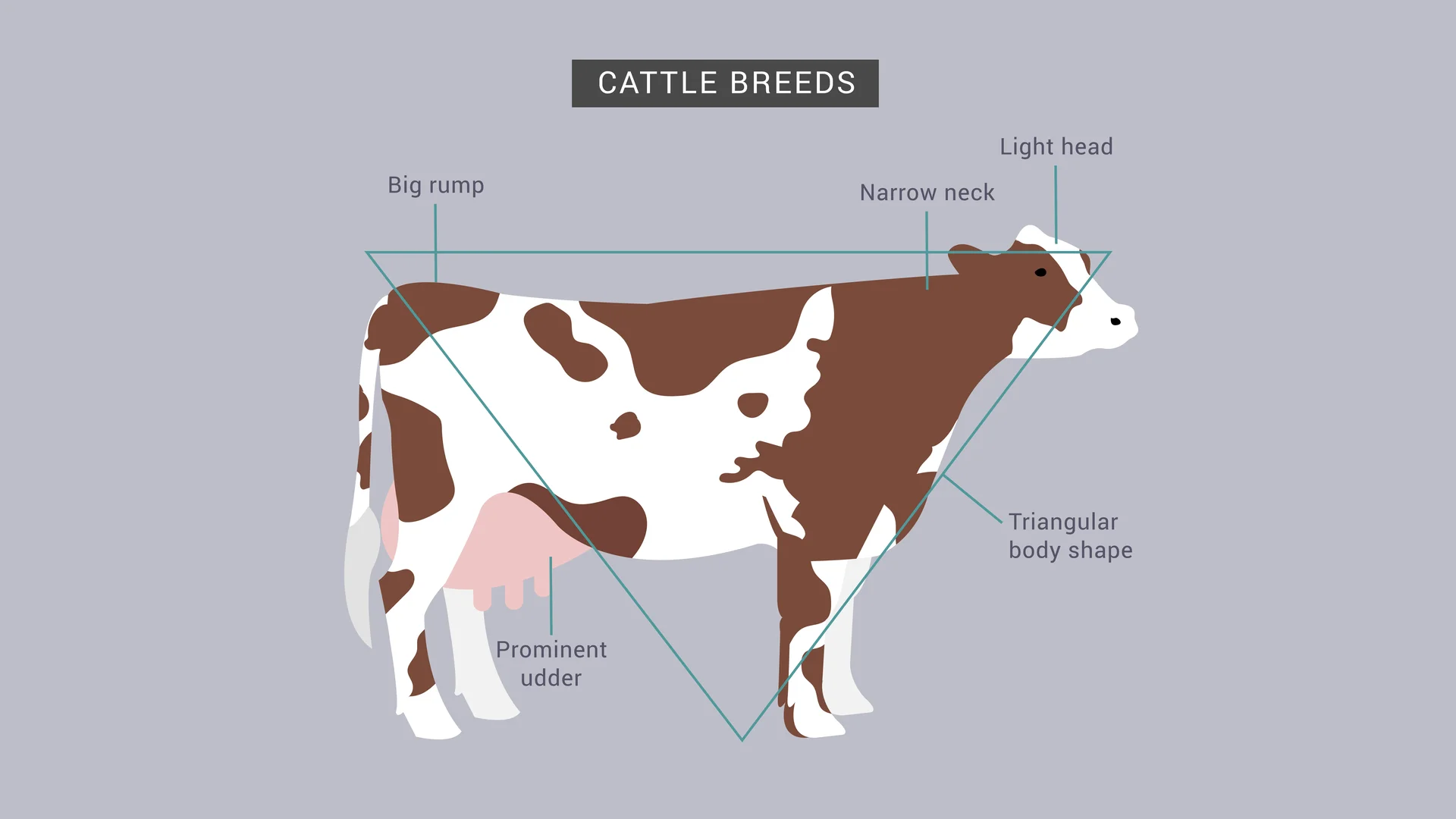
R: What are the main differences between them, apart from the purpose? T: First thing is their exteriermfd0575a6467c7d65_1510586641279_0exterier, that is the appearance. Dairy cows have a triangle‑shaped body. The basis of this triangle is a rumpmfd0575a6467c7d65_1510586666679_0rump with a large uddermfd0575a6467c7d65_1510586691624_0udder, and the apex is a light, extended head on a narrow neckmfd0575a6467c7d65_1510586710894_0neck. F: So, these are the black and white cows which we frequently see on the pastures, right? T: The breed you mentioned is the Holstein breed. These cows are large. Some of them can weigh more than 700 kg or even 800 kg. Mature bullsmfd0575a6467c7d65_1510586750182_0bulls usually weigh 1000‑1300 kg, it is a breed standardmfd0575a6467c7d65_1510586311768_0breed standard. Dairy breeds can differ considerably in terms of the size, weight, or colourmfd0575a6467c7d65_1510586722324_0colour, but they have similar stature. F: Are there any other dairy breeds? T: Yes, of course. Take for example Jersey and Ayrshire breeds. F: And what about meat breeds? T: Meat breeds have a rectangular‑like body shape -a relatively heavy, short head sits on a short and wide neck. Prominent musclesmfd0575a6467c7d65_1510586767268_0muscles are especially visible on a perfectly muscular rump. F: And which meat breeds are reared in Poland? T: In Poland, rearing meat cattle is not popular, but the most well‑known breeds include: Limousine, Hereford, Charolaise, Aberdeen‑Angus, and Piemontese. F: So, which one should I choose? T: Often the best solution is to rear dual‑purpose breedsmfd0575a6467c7d65_1510586780292_0dual‑purpose breeds and to crossbreedmfd0575a6467c7d65_1510586820037_0crossbreed both types. F: Thank you very much then. Your information is very helpful. T: Thank you too and good bye.