You will learn to calculate terms of the sequence defined by the explicit formula or by the recursive formula and to determine monotonicity of the sequence.
Learning effect
You calculate terms of the sequence defined by the explicit formula or by the recursive formula and determine monotonicity of the sequence.
Revise the concept of a function, especially functions whose domain is the set of natural numbers. Revise also terms connected to monotonicity of the function. Prepare information about sequences. See if your material contain following information.
A sequencesequencesequence is a function defined in the set of natural, positive numbers. Values of this function for consecutive natural numbers are terms of the sequenceterms of the sequenceterms of the sequence.
If a sequence is infinite, then its domain is the set of natural, positive numbers. The domain of a finite sequencesequencesequence is the set {1, 2 ,..., n}.
Number sequences are such sequences in which terms are numbers. We mark sequences usually as (aIndeks dolny nn), (bIndeks dolny nn), (cIndeks dolny nn).
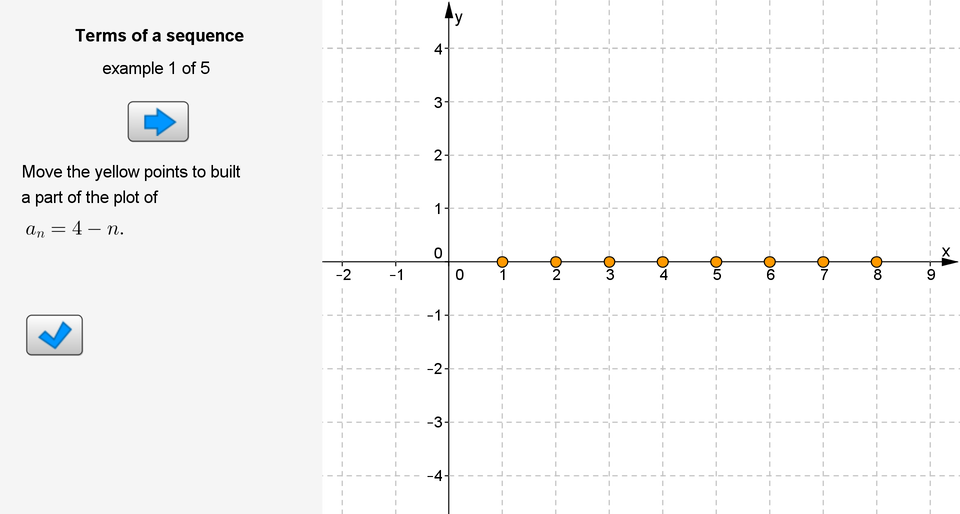
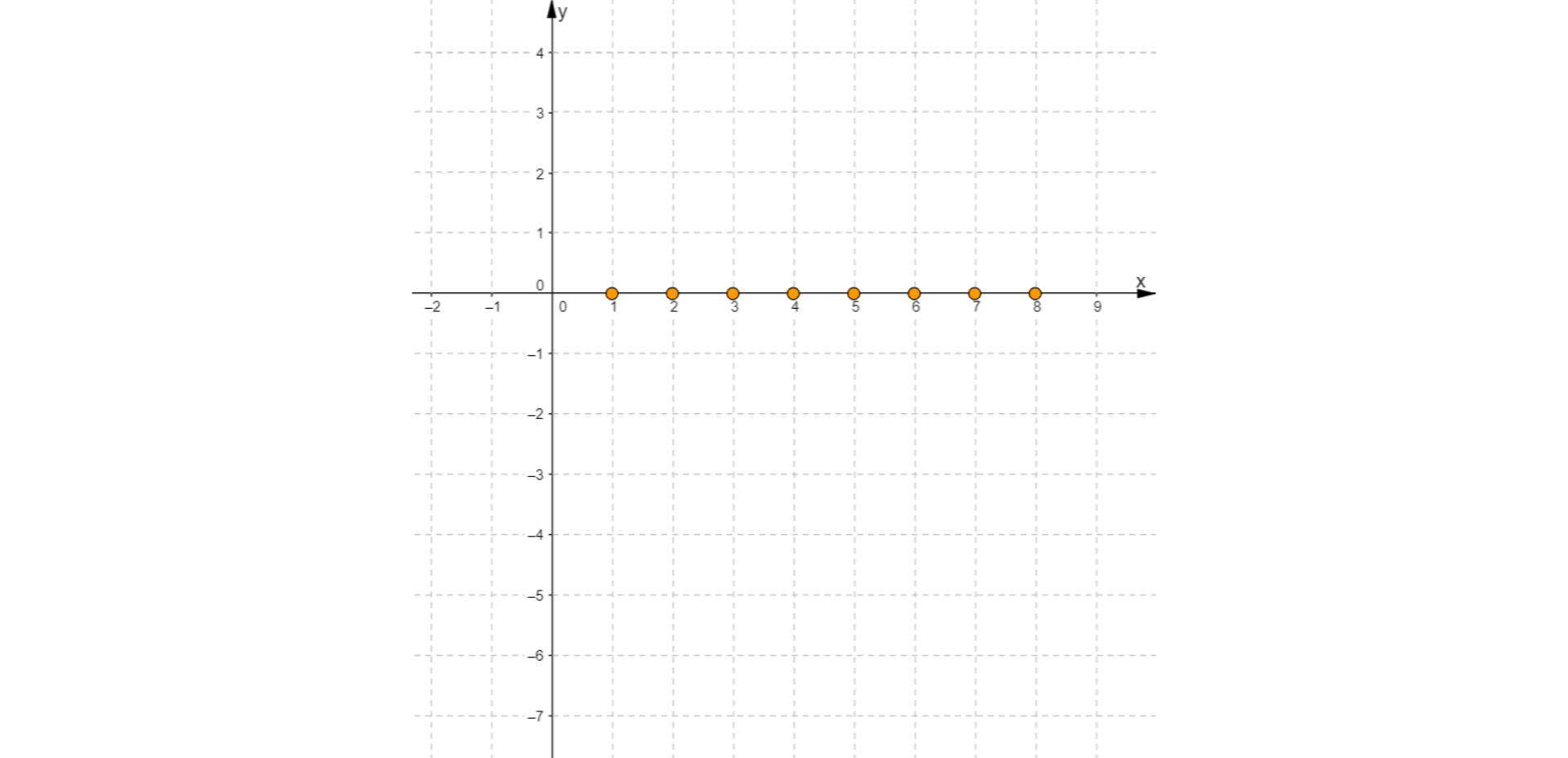
Na rysunku przedstawiony jest prostokątny układ współrzędnych na płaszczyźnie. Zaznaczono na nim punkty na osi x o odciętych: jeden, dwa, trzy, cztery, pięć, sześć, siedem i osiem.
Source: GroMar, licencja: CC BY 3.0.
R1YHxgeLQIJ771
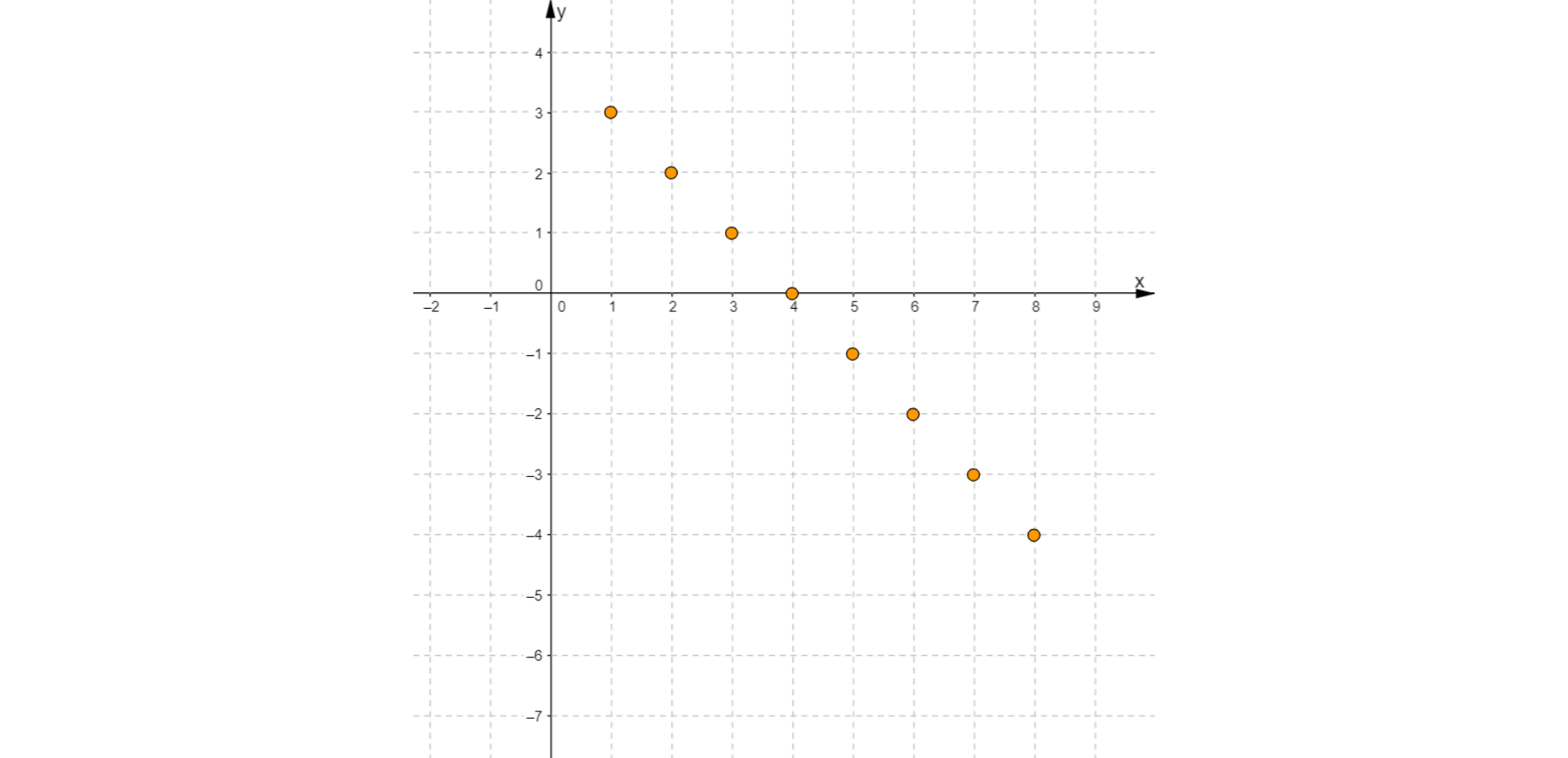
Na rysunku przedstawiony jest prostokątny układ współrzędnych na płaszczyźnie. Zaznaczono na nim punkty, które są wykresem ciągu określonego wzorem n-ty wyraz jest równy cztery odjąć n.
Look at plots and give properties of sequences that they represent.
R15cXNJMJM7WR1
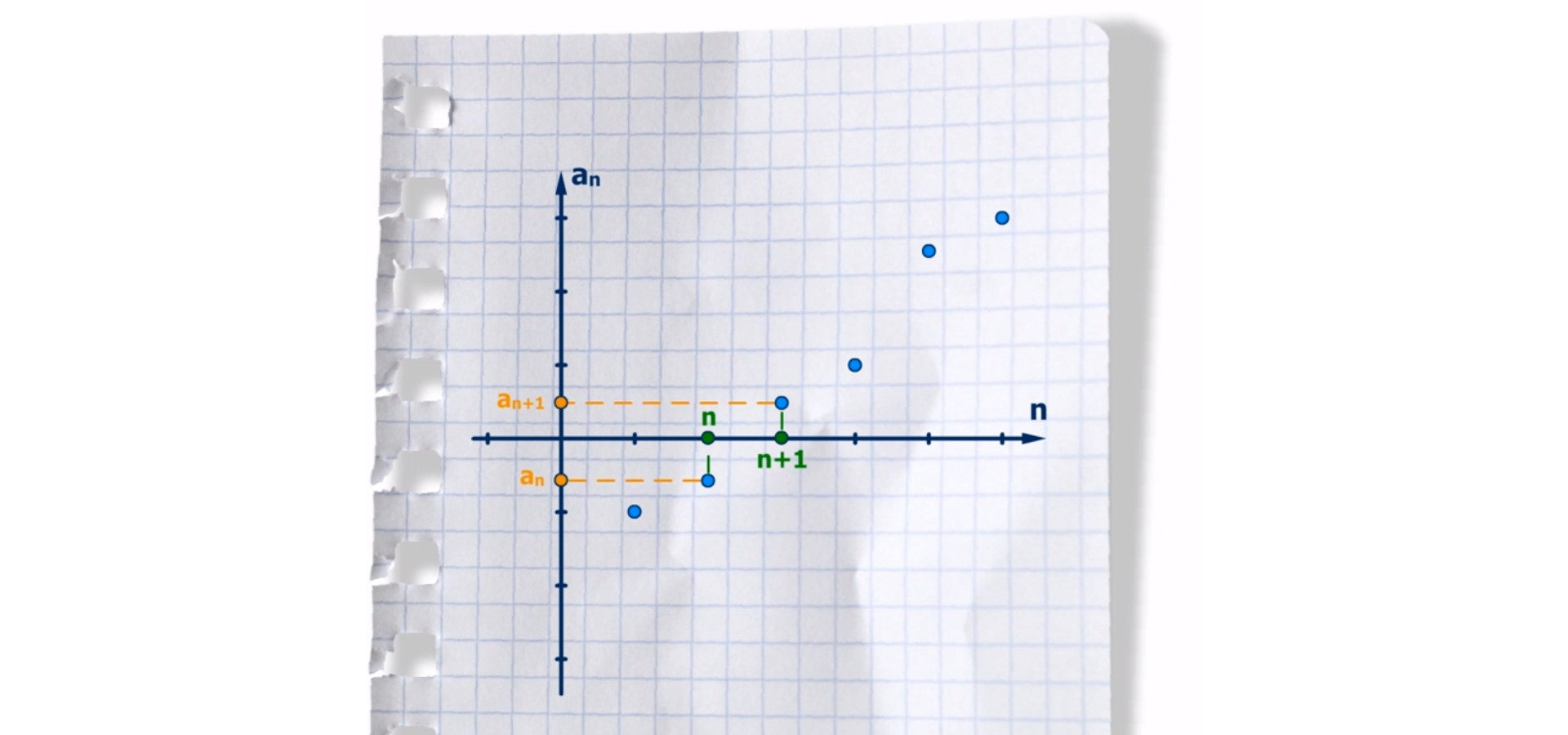
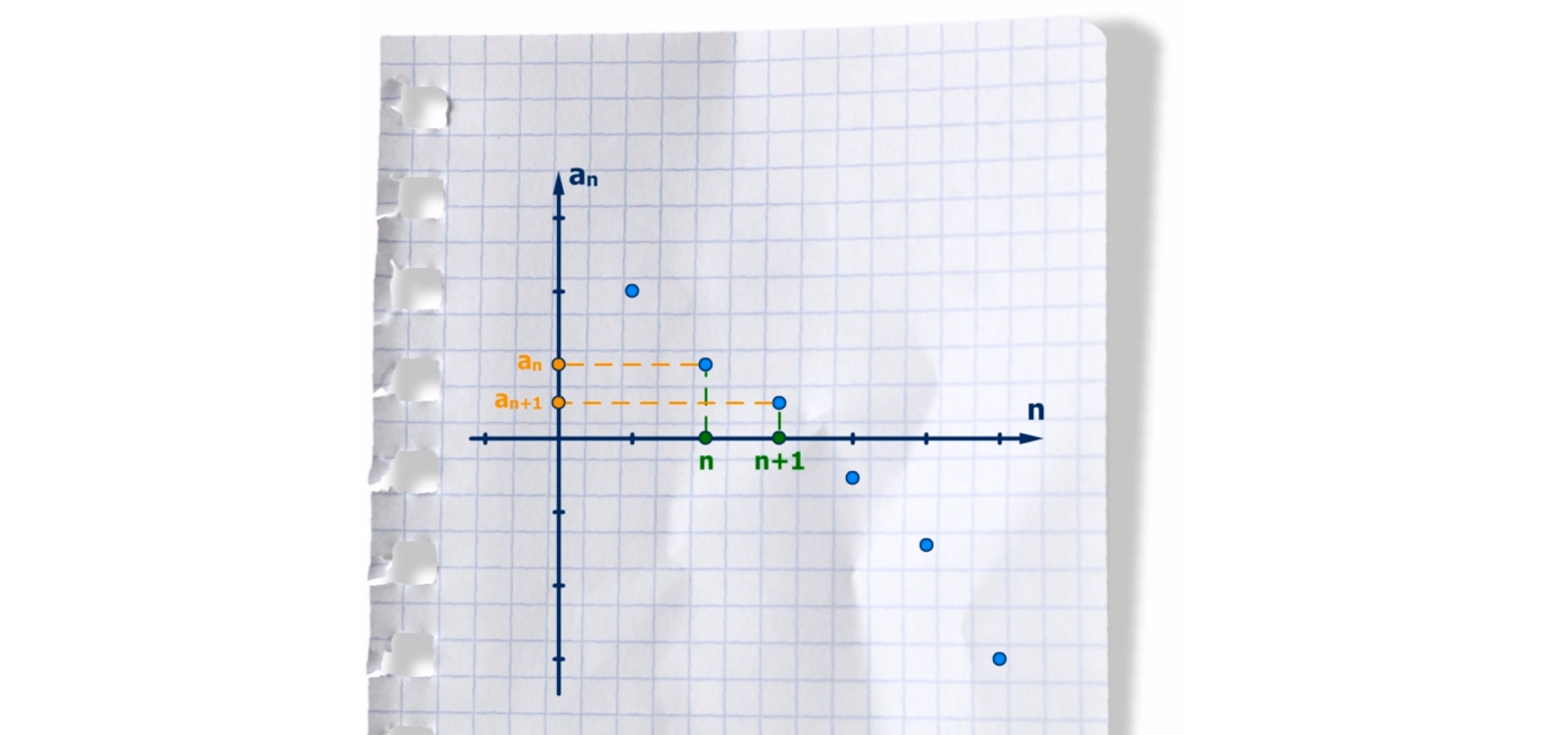
Rysunek przedstawia wykres ciągu rosnącego. Wyrazy ciągu są w postaci punktów w układzie współrzędnych. Każdy wyraz, począwszy od drugiego, jest większy od wyrazu bezpośrednio go poprzedzającego. Oznaczono współrzędne dwóch punktów. Punkt pierwszy ma współrzędne n oraz a w indeksie dolnym n, koniec indeksu dolnego. Drugi punkt ma współrzędne n dodać jeden oraz a w indeksie dolnym n dodać jeden, koniec indeksu dolnego.
Source: GroMar, licencja: CC BY 3.0.
RULyWFVXUcOVx1
Rysunek przedstawia wykres ciągu malejącego. Wyrazy ciągu są w postaci punktów w układzie współrzędnych. Każdy wyraz, począwszy od drugiego, jest mniejszy od wyrazu bezpośrednio go poprzedzającego. Oznaczono współrzędne dwóch punktów. Punkt pierwszy ma współrzędne n oraz a w indeksie dolnym n, koniec indeksu dolnego. Drugi punkt ma współrzędne n dodać jeden oraz a w indeksie dolnym n dodać jeden, koniec indeksu dolnego.
Source: GroMar, licencja: CC BY 3.0.
RFigDaweZqG6K1
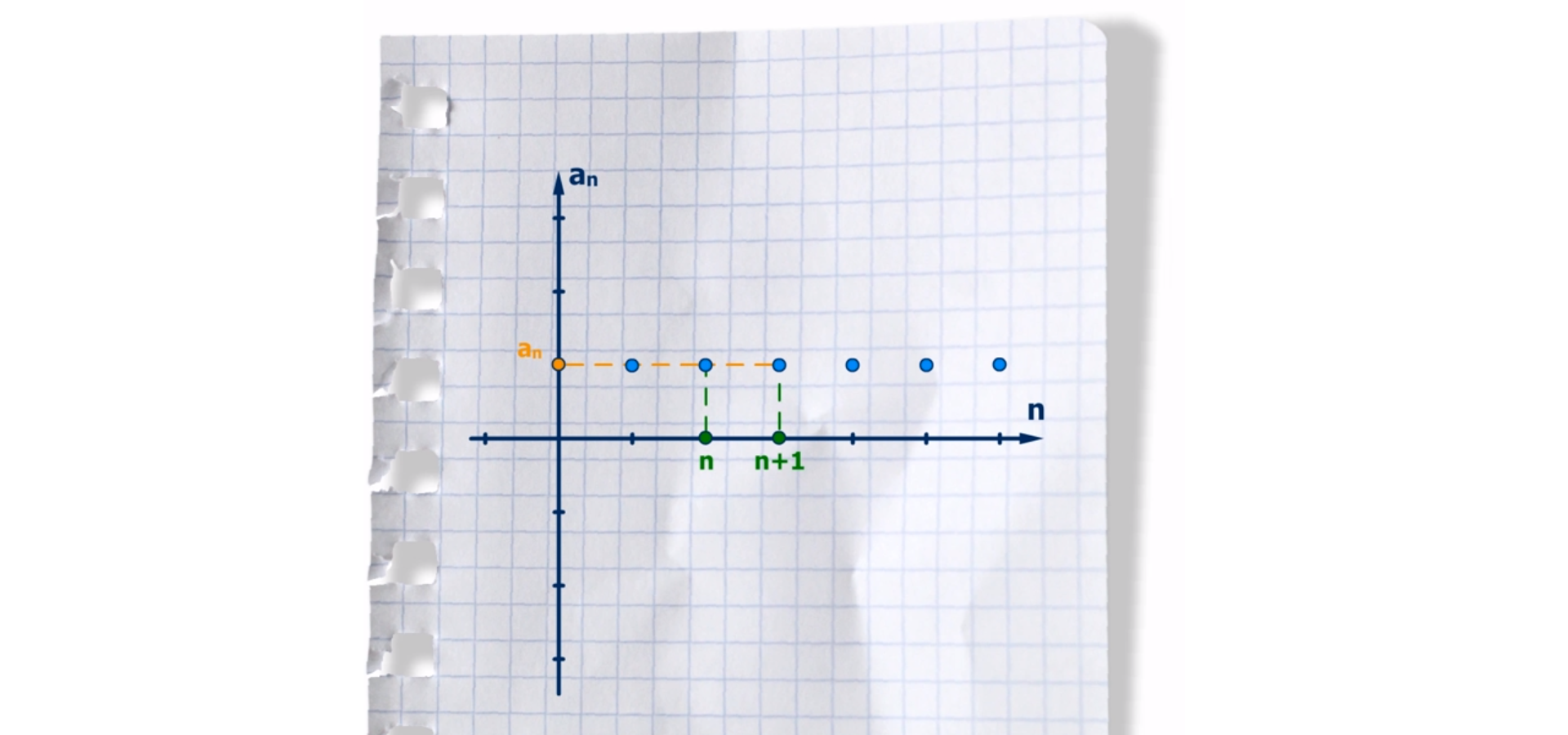
Rysunek przedstawia wykres ciągu stałego. Wyrazy ciągu są w postaci punktów w układzie współrzędnych. Wszystkie wyrazy mają taką samą wartość. Oznaczono współrzędne dwóch punktów. Punkt pierwszy ma współrzędne n oraz a w indeksie dolnym n, koniec indeksu dolnego. Drugi punkt ma współrzędne n dodać jeden oraz a w indeksie dolnym n, koniec indeksu dolnego.
Look at plots and give properties of sequences that they represent.
RnqRE3l5lFNDk1
Rysunek przedstawia wykres ciągu niemalejącego. Wyrazy ciągu są w postaci punktów w układzie współrzędnych. Każdy wyraz, począwszy od drugiego, jest nie mniejszy (większy lub równy) od wyrazu bezpośrednio go poprzedzającego. Oznaczono współrzędne dwóch punktów. Punkt pierwszy ma współrzędne n oraz a w indeksie dolnym n, koniec indeksu dolnego. Drugi punkt ma współrzędne n dodać jeden oraz a w indeksie dolnym n dodać jeden, koniec indeksu dolnego.
Source: GroMar, licencja: CC BY 3.0.
R1Y9QwiVhS2l41
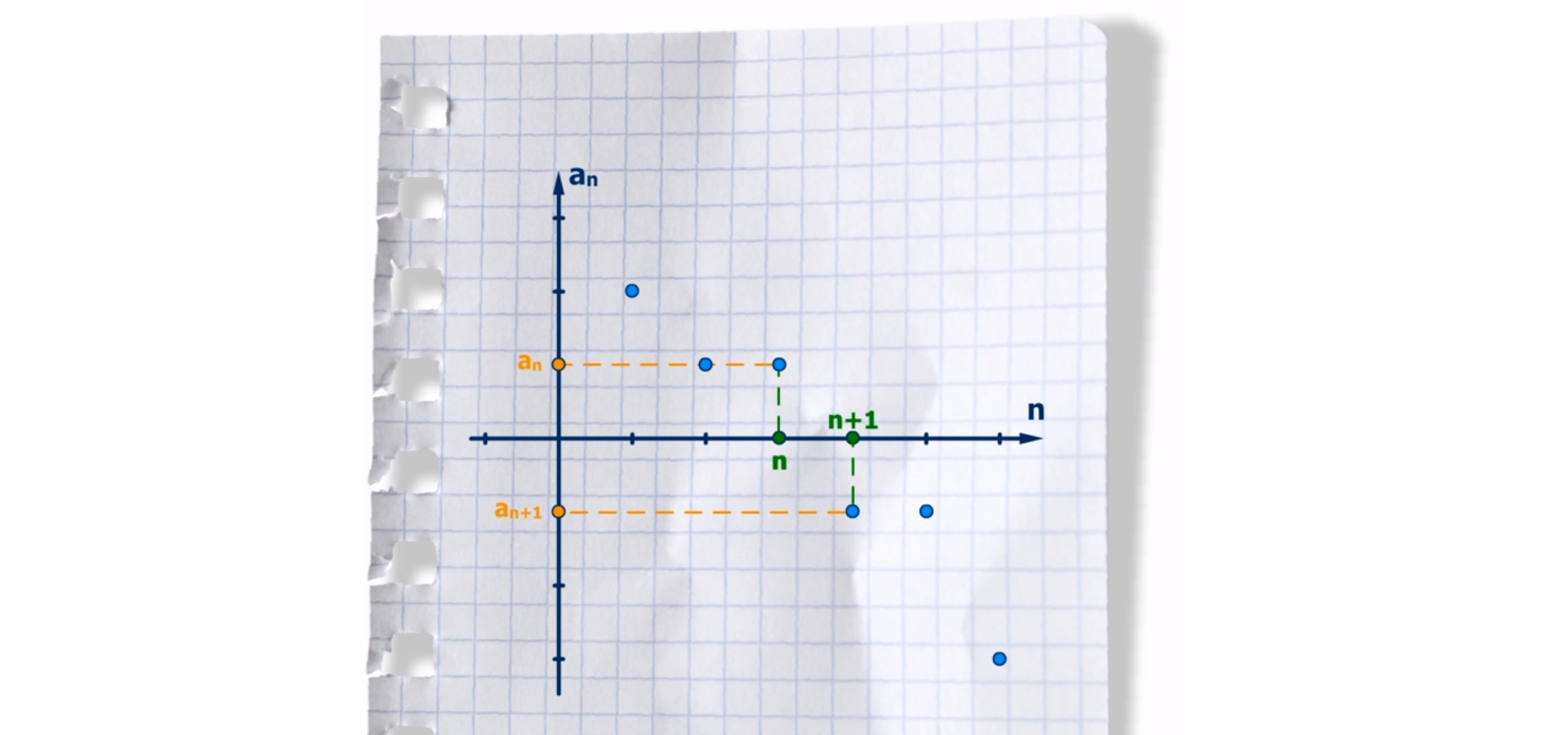
Rysunek przedstawia wykres ciągu nierosnący. Wyrazy ciągu są w postaci punktów w układzie współrzędnych. Każdy wyraz, począwszy od drugiego, jest nie większy (mniejszy lub równy) od wyrazu bezpośrednio go poprzedzającego. Oznaczono współrzędne dwóch punktów. Punkt pierwszy ma współrzędne n oraz a w indeksie dolnym n, koniec indeksu dolnego. Drugi punkt ma współrzędne n dodać jeden oraz a w indeksie dolnym n dodać jeden, koniec indeksu dolnego.
Source: GroMar, licencja: CC BY 3.0.
RCLJZOBnKWEbQ1
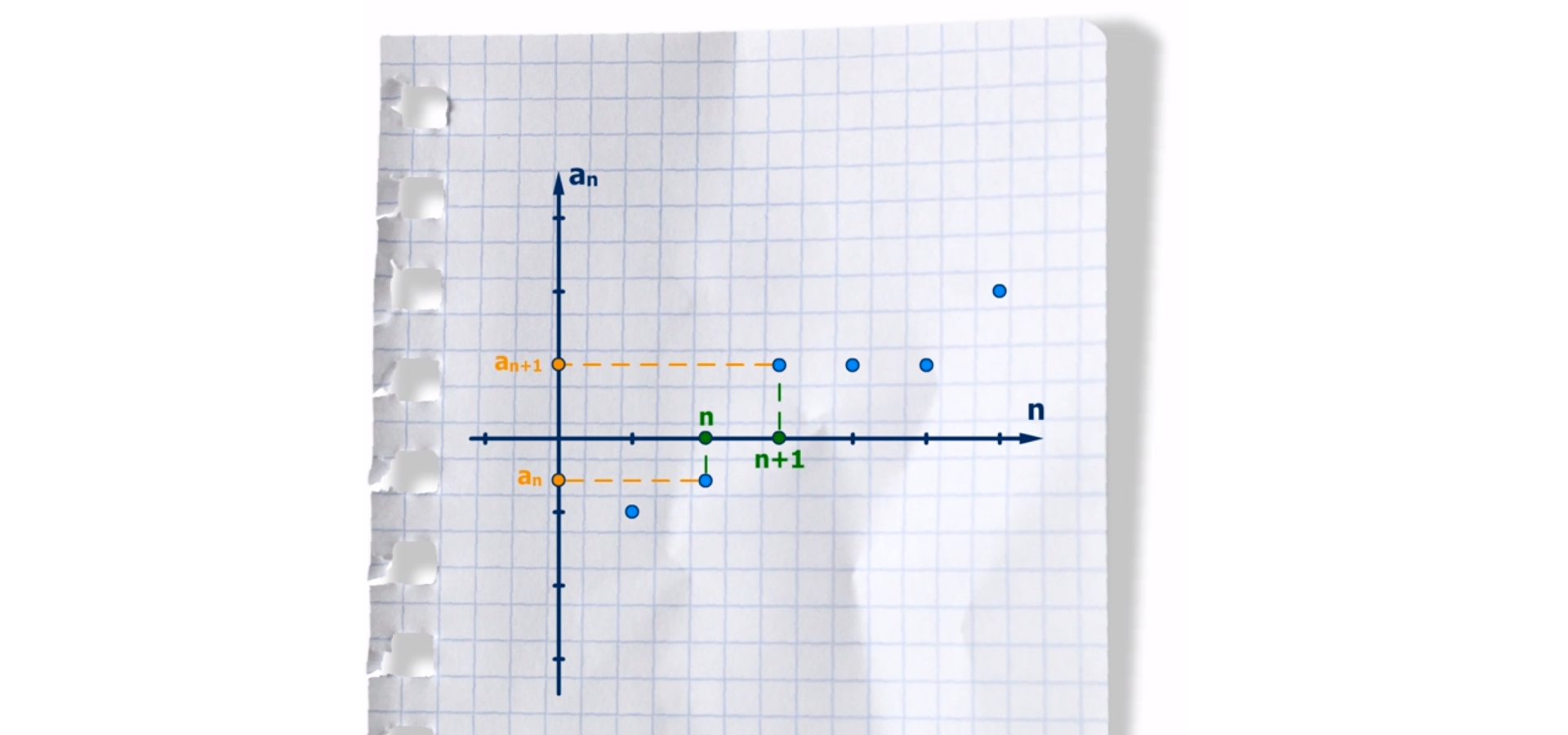
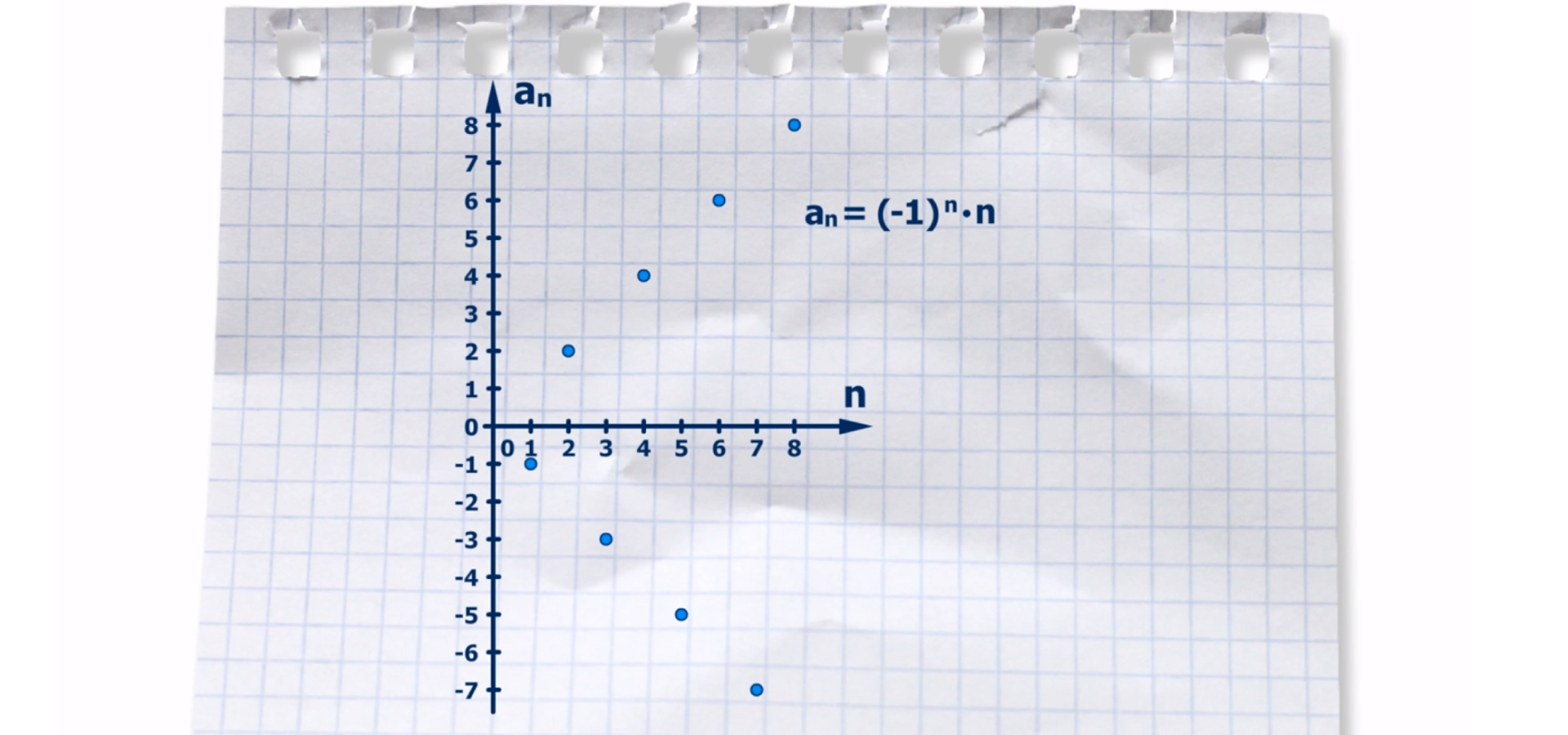
Rysunek przedstawia wykres ciągu mieszanego (niemonotonicznego). Wyrazy ciągu są w postaci punktów w układzie współrzędnych. Każdy wyraz ciągu może być większy, równy lub mniejszy od wyrazu bezpośrednio go poprzedzającego. W przykładzie na rysunku wyraz ciągu jest naprzemiennie większy lub mniejszy od wyrazu bezpośrednio go poprzedzającego. Zapisany jest wzór ciągu. a w indeksie dolnym n, koniec indeksu dolnego równa się w nawiasie minus jeden, zamknąć nawias, w indeksie górnym n, koniec indeksu górnego, razy n.
A sequencesequencesequence is called increasing if each one of its terms, starting from the second one, is greater than the directly preceding term, so for each positive integer n there is the inequality aIndeks dolny n+1n+1 > aIndeks dolny nn.
A sequence is called decreasing if each one of its terms, starting from the second one, is smaller than the directly preceding term, so for each positive integer n there is the inequality aIndeks dolny n+1n+1 < aIndeks dolny nn.
A sequence is called constant if all terms of this sequencesequencesequence are equal so for any each positive integer n there is the equality aIndeks dolny n+1n+1 = aIndeks dolny nn.
A sequencesequencesequence is called non‑decreasing if each one of its terms, starting from the second one, is not smaller than the directly preceding term, so for each positive integer n there is the inequality n .
A sequence is called non‑increasing if each one of its terms, starting from the second one, is not greater than the directly preceding term, so for each positive integer n there is the inequality .
If a sequence is increasing, decreasing, non‑increasing, non‑decreasing or constant, then we say that this sequencesequencesequence is monotonic. Other sequence are non‑monotonic.
A sequencesequencesequence is a function defined in the set of natural, positive numbers. Values of this function for consecutive natural numbers are terms of the sequenceterms of the sequenceterms of the sequence. A sequence is monotonic if it is increasing, decreasing, non‑increasing, non‑decreasing or constant:
The sequencesequencesequence (aIndeks dolny nn) is increasing, if .
The sequence (aIndeks dolny nn) is decreasing, if .
The sequencesequencesequence (aIndeks dolny nn) is constant, if .
The sequence (aIndeks dolny nn) is non‑decreasing, if .
The sequencesequencesequence (aIndeks dolny nn) is non‑increasing, if .
Exercises
R7CPrTGpxnyg5
Exercise 1
Wersja alternatywna ćwiczenia: A sequence whose general term is: . Determine which sentences are true. Możliwe odpowiedzi: 1. is increasing, 2. has seven negative terms, 3. has all non-negative terms, 4. is not monotonic
Wersja alternatywna ćwiczenia: A sequence whose general term is: . Determine which sentences are true. Możliwe odpowiedzi: 1. is increasing, 2. has seven negative terms, 3. has all non-negative terms, 4. is not monotonic
A sequence whose general term is: . Determine which sentences are true.
is increasing
has seven negative terms
has all non-negative terms
is not monotonic
zadanie
Source: GroMar, licencja: CC BY 3.0.
Exercise 2
Prove that the sequence (an) is decreasing:
Check the sign of the difference aIndeks dolny n+1n+1 - aIndeks dolny nn.
Exercise 3
In English, describe an example of a sequence that is not a number sequence.
Exercise 4
Rvk5OAkpixyYP
Wersja alternatywna ćwiczenia: Indicate which pairs of expressions or words are translated correctly. Możliwe odpowiedzi: 1. ciąg - sequence, 2. wyrazy ciągu - terms of the sequence, 3. ciąg monotoniczny - monotonic sequence, 4. ciąg rosnący - increasing sequence, 5. ciąg malejący - constant sequence, 6. ciąg stały - monotonic sequence
Wersja alternatywna ćwiczenia: Indicate which pairs of expressions or words are translated correctly. Możliwe odpowiedzi: 1. ciąg - sequence, 2. wyrazy ciągu - terms of the sequence, 3. ciąg monotoniczny - monotonic sequence, 4. ciąg rosnący - increasing sequence, 5. ciąg malejący - constant sequence, 6. ciąg stały - monotonic sequence
Indicate which pairs of expressions or words are translated correctly.
ciąg - sequence
wyrazy ciągu - terms of the sequence
ciąg monotoniczny - monotonic sequence
ciąg rosnący - increasing sequence
ciąg malejący - constant sequence
ciąg stały - monotonic sequence
zadanie
Source: GroMar, licencja: CC BY 3.0.
R6hCne6DwsV1w1
Interaktywna gra, polegająca na łączeniu wyrazów w pary w ciągu jednej minuty. Czas zaczyna upływać wraz z rozpoczęciem gry. Jeden ruch to odkrywanie najpierw jednej potem drugiej karty z wyrazem. Każdy wyraz jest odczytywany. Kolejny ruch to odkrywanie trzeciej i czwartej karty. W ten sposób odsłuchasz wszystkie wyrazy. Nawigacja z poziomu klawiatury za pomocą strzałek, odsłuchiwanie wyrazów enterem lub spacją. Znajdź wszystkie pary wyrazów.
Interaktywna gra, polegająca na łączeniu wyrazów w pary w ciągu jednej minuty. Czas zaczyna upływać wraz z rozpoczęciem gry. Jeden ruch to odkrywanie najpierw jednej potem drugiej karty z wyrazem. Każdy wyraz jest odczytywany. Kolejny ruch to odkrywanie trzeciej i czwartej karty. W ten sposób odsłuchasz wszystkie wyrazy. Nawigacja z poziomu klawiatury za pomocą strzałek, odsłuchiwanie wyrazów enterem lub spacją. Znajdź wszystkie pary wyrazów.
Match Polish terms with their English equivalents.
ciąg rosnący
decreasing sequence
terms of the sequence
wyrazy ciągu
ciąg monotoniczny
ciąg malejący
increasing sequence
sequence
ciąg
monotonic sequence
Source: Zespół autorski Politechniki Łódzkiej, licencja: CC BY 3.0.